
Most businesses do not start with an accounting department.
In the early stages, the owner may handle financial tasks directly, or the business may rely on a bookkeeper to keep records organized and prepare information for tax filing.
That usually works for a while.
But as a company grows, financial operations become more demanding.
There are more transactions.
More employees.
More vendors.
More decisions that depend on timely and reliable financial information.
At some point, many business owners start asking a very practical question:
When does a business need an accounting department?
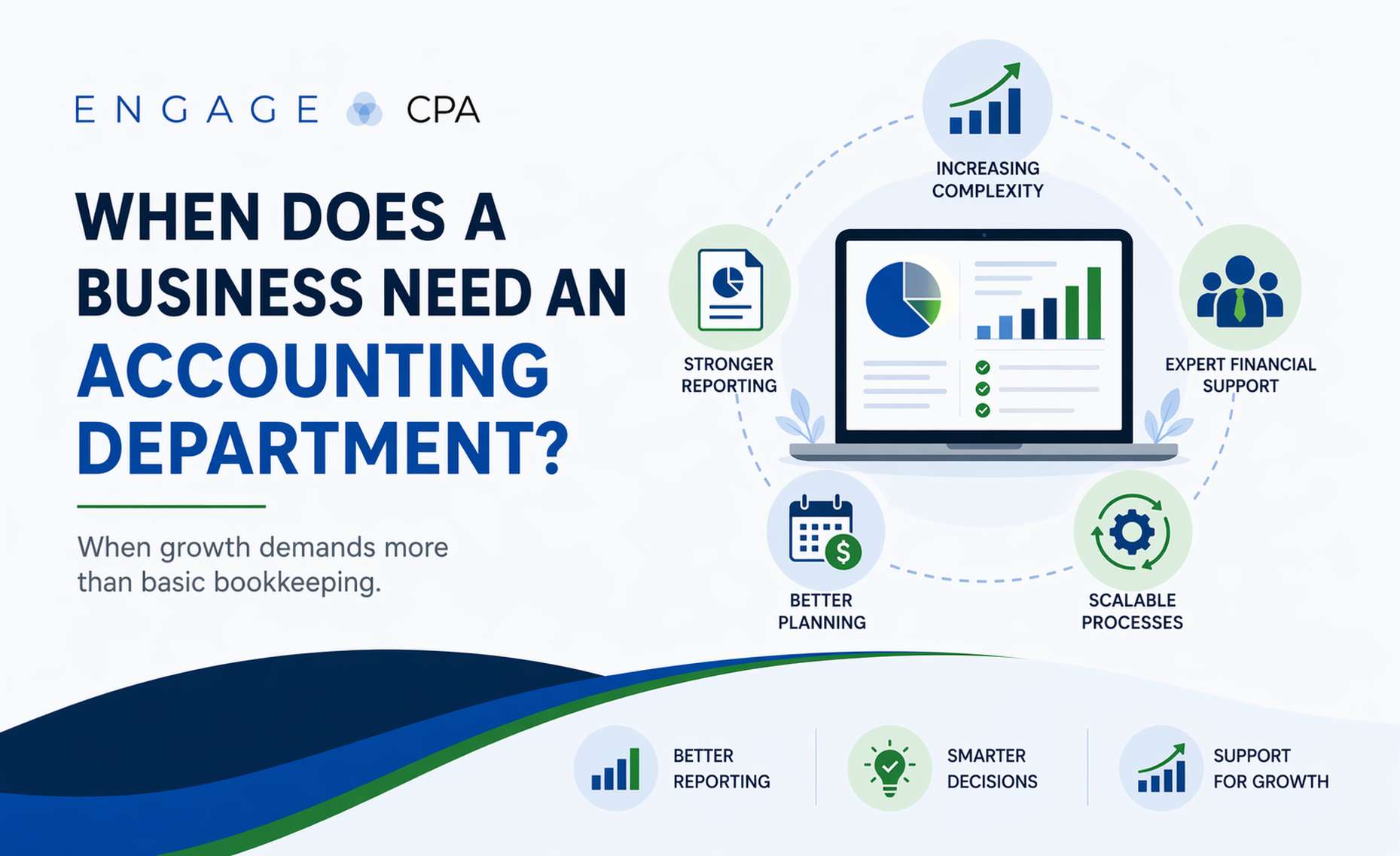
The answer depends on complexity more than age. In many cases, the shift happens when the business no longer needs just transaction recording—it needs structure, reporting, oversight, and financial reliability.
In this article, we’ll explain when that shift usually happens, what signs to watch for, and what growing businesses typically do next.
What an Accounting Department Actually Does
Before answering when a business needs one, it helps to clarify what an accounting department is.
An accounting department is not just bookkeeping.
Bookkeeping focuses on recording financial transactions accurately.
An accounting department is responsible for the broader financial infrastructure of a business, including:
• maintaining accurate books
• producing consistent financial reports
• organizing accounting workflows
• supporting tax and compliance readiness
• providing financial visibility for leadership
In larger companies, this work may be done by an internal team.
In growing businesses, it is often handled by a mix of internal staff or an outsourced accounting department.
👉 For a deeper explanation, see:
/resources/what-is-outsourced-accounting-department
Most Businesses Need an Accounting Department When Complexity Outgrows Bookkeeping
A business usually needs an accounting department when financial complexity has grown beyond what basic bookkeeping can support.
This does not necessarily mean the company needs a large internal finance team.
It means the business now needs:
• more structured reporting
• more reliable processes
• more oversight
• better financial organization
In practice, this often begins when businesses move out of the very early stage and into sustained growth.
That can happen around $1M–$5M in revenue, but revenue alone does not tell the whole story.
Some businesses need more structure earlier. Others can operate longer with a simpler setup.
The real trigger is operational and financial complexity.
7 Signs a Business May Need an Accounting Department
1. Financial Reports Are Late or Inconsistent
One of the clearest signs is that month-end reporting is unreliable.
If leadership is waiting too long for financial reports—or getting them inconsistently—it usually means the financial function needs more structure.
2. Leadership Doesn’t Fully Trust the Numbers
When business owners feel uncertain about the accuracy of financial reports, it becomes harder to make decisions confidently.
That loss of trust is often a signal that the business needs stronger accounting processes and oversight.
3. The Business Has More Employees, Vendors, and Transactions
As transaction volume grows, financial complexity grows with it.
More payroll activity, vendor relationships, and invoicing usually create pressure on systems that were originally built for a simpler business.
4. Tax Season Is Always Reactive
If year-end is consistently stressful, it often means the accounting function is too reactive.
An accounting department keeps financial records organized throughout the year so reporting and tax filing do not become a last-minute scramble.
5. Accounting Processes Feel Unclear
Many growing businesses begin to experience problems like:
• scattered financial documentation
• inconsistent approval processes
• unclear workflows around payments or invoicing
• difficulty finding reliable financial information
These are process problems, not just bookkeeping problems.
6. The Business Needs Better Financial Visibility
As a company grows, leadership usually needs more insight into:
• profitability
• cash flow
• revenue trends
• cost structure
Basic bookkeeping rarely provides enough structure for this level of visibility.
7. One Person Has Become a Bottleneck
In some businesses, one bookkeeper or admin person ends up carrying too much of the financial workload.
When all financial activity depends on one person, the business becomes vulnerable to delays, errors, and operational risk.
Revenue Is a Clue — But Not the Whole Answer
Many businesses start needing an accounting department somewhere between $1M and $20M in revenue.
But revenue is only one indicator.
A business may need an accounting department earlier if it has:
• multiple service lines
• project-based work
• complex payroll
• fast growth
• frequent financial decision-making needs
A lower-revenue business with complexity may need more structure than a higher-revenue business with simple operations.
That’s why the better question is not just:
“How big are we?”
It’s:
“How much financial structure do we need to operate confidently?”
What Businesses Usually Do at This Stage
When companies realize they need more than bookkeeping, they usually consider three paths.
Option 1: Keep Pushing the Existing Setup
Some businesses try to keep operating with the same bookkeeping arrangement, even though complexity has increased.
This usually creates more friction over time.
Option 2: Build an Internal Accounting Team
Some businesses begin hiring:
• accountant
• controller
• finance staff
This can work, but it introduces cost, hiring difficulty, and management responsibility.
👉 See our comparison here:
/resources/outsourced-accounting-vs-hiring-internal-accountant
Option 3: Use an Outsourced Accounting Department
Many growing businesses choose to work with an outsourced accounting team.
This gives them access to:
• consistent reporting
• reliable financial processes
• year-end readiness
• accounting structure without internal hiring
For many companies, this is the most efficient way to create financial infrastructure without building a full in-house team too early.
When a Business Needs More Than a Bookkeeper
This is often the real turning point.
A business usually needs an accounting department when it needs more than a person to record transactions.
It needs:
• reporting cadence
• process consistency
• financial oversight
• readiness for tax and compliance
• support for leadership decision-making
That is a fundamentally different level of need.
👉 If you’re still assessing that transition, read:
/resources/bookkeeping-vs-accounting-growing-business
And if you suspect your current setup is already under strain, also see:
/resources/signs-your-business-has-outgrown-bookkeeping
When Growing Businesses in Calgary and Across Canada Reach This Stage
For businesses in Calgary, Alberta, and across Canada, this transition is becoming more common as companies grow faster and operate with more complexity.
Many leadership teams are looking for better financial visibility without taking on the burden of building an internal finance team too early.
That’s why more businesses are turning to CPA-led outsourced accounting services to create structure, consistency, and reliable financial operations.
How Engage CPA Helps Businesses at This Stage
Engage CPA provides a CPA-led outsourced accounting department for growing businesses in Calgary, Alberta, and across Canada.
We help businesses that have reached the point where basic bookkeeping is no longer enough by providing:
• organized financial records
• consistent monthly reporting
• structured accounting workflows
• year-end and T2 readiness
• CPA oversight and financial reliability
For companies that need more structure without immediately hiring an internal team, this model often provides the right next step.
Frequently Asked Questions
Does every business need an accounting department?
Not immediately. Very small and simple businesses may only need bookkeeping at first. But as complexity grows, most businesses eventually need more structured accounting support.
At what revenue does a business usually need an accounting department?
Many businesses begin needing one somewhere between $1M and $5M in revenue, though the real trigger is complexity, not revenue alone.
Can an outsourced accounting department replace an internal team?
For many growing businesses, yes. An outsourced accounting department can provide the structure, reporting, and oversight they need without the cost and management burden of building an internal team.
Final Thoughts
A business needs an accounting department when financial complexity has outgrown basic bookkeeping.
That usually shows up through delayed reporting, reduced confidence in the numbers, disorganized processes, and increasing pressure on leadership to make decisions without clear financial visibility.
The shift does not always mean hiring a full in-house team.
For many growing businesses, it means building the right financial structure in the most practical way possible.
That is often the point where an outsourced accounting department becomes the right fit.

