
As businesses grow, their financial needs become harder to manage.
What used to be handled with basic bookkeeping often expands into reporting, payroll coordination, accounts payable and receivable, year-end preparation, and more structured financial oversight.
At some point, many business owners face a practical question:
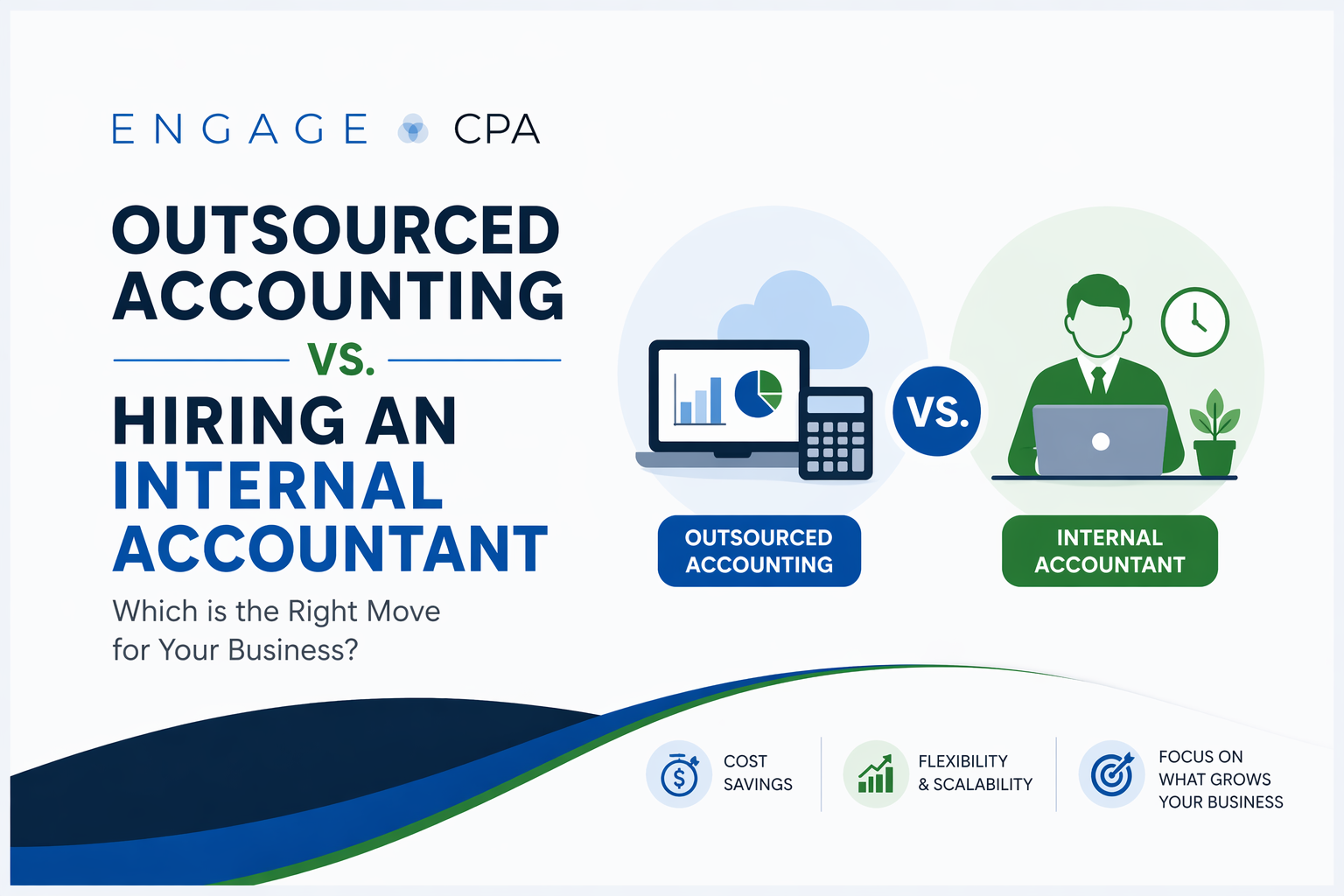
Should we hire an internal accountant, or should we outsource the accounting function?
There is no one-size-fits-all answer. But for many growing businesses, the decision comes down to cost, complexity, reliability, and how much financial structure the company actually needs.
In this article, we’ll compare outsourced accounting vs hiring an internal accountant, and look at which option tends to make the most sense at different stages of growth.
Why Businesses Reach This Decision Point
Most businesses don’t start out thinking they need an accountant.
In the early stages, bookkeeping is often enough to keep records organized and support tax preparation.
But as the business grows, financial operations become more demanding.
More transactions.
More employees.
More vendors.
More decisions that depend on reliable numbers.
That’s usually when leadership begins to notice problems such as:
• financial reports arriving late
• lack of confidence in the numbers
• tax season becoming stressful
• accounting processes feeling disorganized
• increasing pressure on the person doing the books
👉 If this sounds familiar, read:
/resources/signs-your-business-has-outgrown-bookkeeping
Once these issues appear, businesses usually begin evaluating two main options:
- hire internally
- outsource the accounting function
What Hiring an Internal Accountant Usually Means
Hiring an internal accountant sounds straightforward.
In practice, though, one internal hire often does not solve the full problem.
That’s because a growing business usually needs more than a single person recording transactions.
Depending on the complexity of the business, internal accounting may involve some combination of:
• bookkeeper
• accountant
• senior accountant
• controller
Even when a company starts with one accountant, the needs of the business often continue to grow around them.
Benefits of Hiring Internally
Hiring in-house can make sense in some situations.
Potential benefits include:
• someone physically inside the business
• direct day-to-day access
• internal familiarity with the team and operations
• tighter integration with leadership if the role is strong
For larger businesses with enough complexity and budget, an internal accounting team may be the right long-term structure.
Challenges of Hiring Internally
For many growing companies, though, internal hiring comes with real costs and operational issues.
These often include:
• time spent recruiting qualified candidates
• onboarding and training
• salary, benefits, and payroll costs
• sick days, vacation, and turnover
• lack of backup when one person is unavailable
• the need to supervise and manage accounting staff
In other words, hiring internally is not just about paying for accounting work.
It also means taking on the responsibility of building and managing part of a finance function.
What Outsourced Accounting Usually Means
Outsourced accounting gives a business access to an external accounting team instead of building one internally.
Rather than hiring one person and hoping they can cover everything, the company works with a structured team responsible for maintaining financial records, reporting, compliance readiness, and accounting workflows.
A strong outsourced accounting department typically includes:
• bookkeeping and reconciliations
• monthly financial reporting
• accounting oversight
• year-end readiness
• support for payroll, payables, and receivables
• CPA-level review and structure
👉 For a deeper explanation, see:
/resources/what-is-outsourced-accounting-department
The Cost Comparison: Internal Hire vs Outsourced Accounting
This is often where the conversation becomes clearer.
Hiring internally may involve:
• Bookkeeper: $55k–$75k
• Accountant: $70k–$100k
• Controller: $110k–$160k
That does not include:
• benefits
• payroll taxes
• recruitment fees
• software costs
• management time
• risk of turnover
Many businesses underestimate the real cost of building even a basic internal accounting function.
Outsourced accounting, by contrast, usually provides access to a broader set of capabilities at a lower monthly cost.
For many growing businesses, that means:
• predictable pricing
• no hiring process
• no coverage issues during vacation or sick leave
• no dependency on one employee
This is one of the biggest reasons companies choose outsourcing before building an internal team.
Reliability and Continuity
One internal employee can become a single point of failure.
If they leave, take vacation, or become unavailable during a busy period, financial operations can slow down quickly.
That risk becomes even more serious around:
• month-end
• payroll
• year-end reporting
• tax filing deadlines
An outsourced accounting team reduces that risk.
Because the work is supported by multiple professionals, there is usually greater continuity and less disruption when one person is unavailable.
For growing businesses, that reliability can be a major advantage.
Oversight and Structure
This is where the comparison becomes more strategic.
Hiring an internal accountant gives you a person.
Outsourcing ideally gives you a system.
A strong outsourced accounting department should bring:
• defined workflows
• consistent reconciliation processes
• reporting cadence
• documented financial procedures
• tax-ready records throughout the year
That structure is often more valuable than simply adding another person.
This is especially true for businesses that feel like their financial operations are reactive, inconsistent, or overly dependent on one individual.
Which Option Is Better for Growing Businesses?
For many businesses in the $1M–$20M revenue range, outsourcing is often the better first step.
Why?
Because these companies usually need:
• more structure than bookkeeping alone provides
• better financial visibility
• accounting support that scales with growth
• a team, but not necessarily full-time payroll
In this stage, building an internal accounting team can be expensive and operationally heavy.
Outsourcing often provides a better balance of:
• cost
• reliability
• flexibility
• financial structure
As the company continues to grow, leadership may eventually decide to build more finance capability internally.
But for many businesses, outsourced accounting is the most efficient way to create reliable financial infrastructure first.
Outsourced Accounting vs Hiring Internally in Calgary and Across Canada
For businesses in Calgary, Alberta, and across Canada, this decision is becoming more common.
Many growing companies are trying to improve their financial operations without taking on the cost and complexity of building a full internal finance team.
That’s why outsourced accounting has become an increasingly attractive model.
It allows business owners to gain:
• structured monthly reporting
• organized accounting records
• year-end and tax readiness
• stronger financial visibility
without the hiring burden that comes with an internal team.
How Engage CPA Helps Growing Businesses
Engage CPA provides a CPA-led outsourced accounting department for growing businesses in Calgary, Alberta, and across Canada.
Our team helps companies move beyond basic bookkeeping and build reliable financial operations through:
• organized financial records
• consistent monthly reporting
• tax-ready accounting systems
• structured workflows and oversight
For companies that need more than bookkeeping but are not ready to build a full internal finance team, outsourced accounting often provides the right next step.
Frequently Asked Questions
Is outsourced accounting cheaper than hiring an accountant?
In many cases, yes. Once salaries, benefits, payroll taxes, and management time are considered, outsourcing can be significantly more cost-effective.
When should a business hire internally instead of outsourcing?
Larger businesses with enough complexity, leadership structure, and budget may eventually benefit from building an internal team. But many growing companies benefit from outsourcing first.
Can outsourced accounting replace a full internal finance team?
For many growing businesses, yes. An outsourced accounting department can provide bookkeeping, reporting, oversight, and year-end support without the need for multiple internal hires.
Final Thoughts
The decision between outsourced accounting vs hiring an internal accountant depends on the size, complexity, and stage of the business.
But for many growing companies, outsourcing provides the financial structure they need without the cost and management burden of internal hiring.
If the goal is to improve financial operations, increase visibility, and avoid the headaches of building an internal team too early, outsourced accounting is often the more practical choice.

