
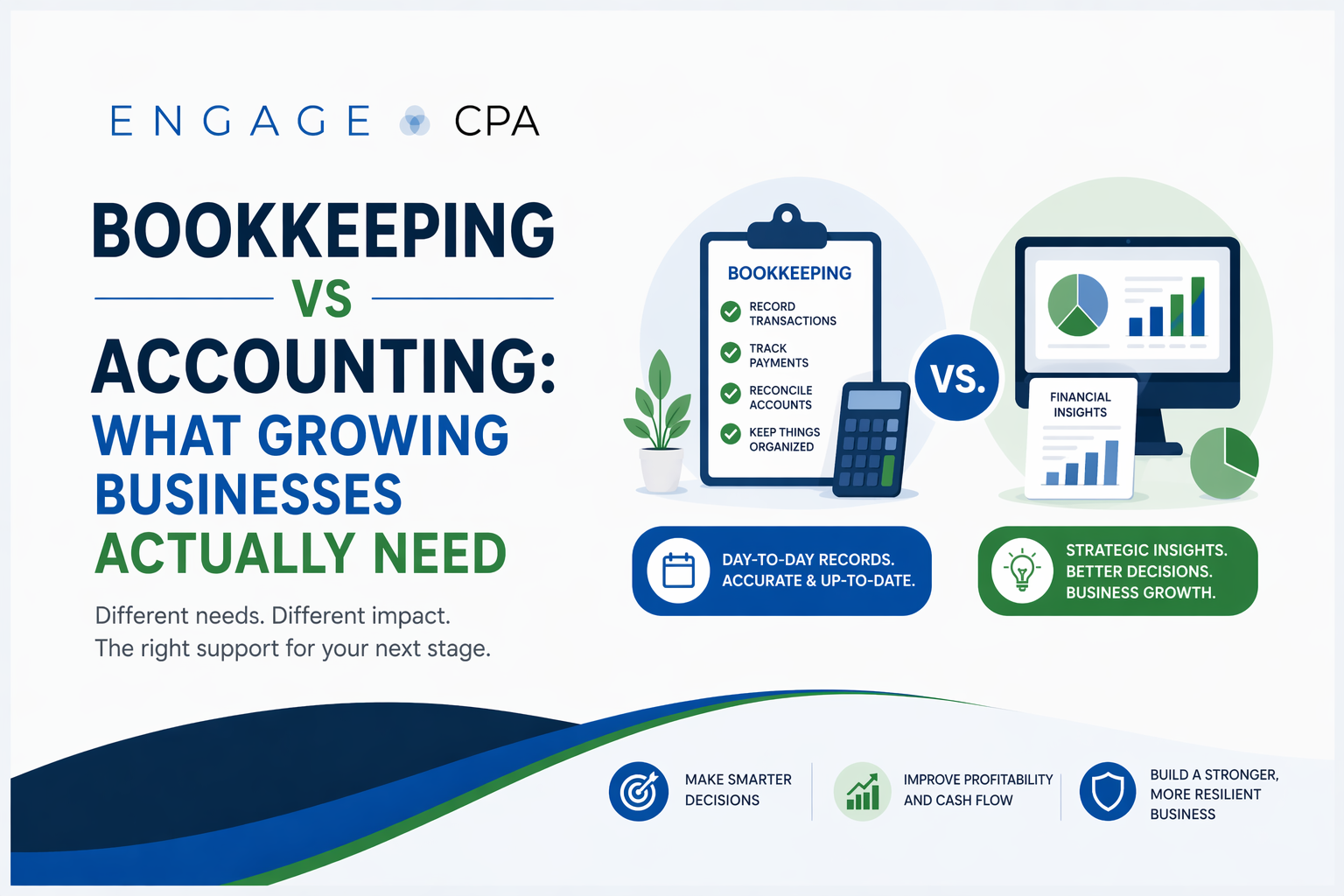
Most businesses start with bookkeeping.
At the early stages, that’s exactly what’s needed—transactions are recorded, expenses are categorized, and financial records are kept organized for tax time.
But as a business grows, a common question starts to come up:
Do we still just need bookkeeping, or do we need something more?
The distinction between bookkeeping and accounting becomes much more important as companies scale. And understanding that difference can be the key to building a business with reliable financial operations.
What Is Bookkeeping?
Bookkeeping is the foundation of any accounting system.
It focuses on recording financial activity accurately and consistently.
Typical bookkeeping responsibilities include:
• recording income and expenses
• categorizing transactions
• reconciling bank and credit card accounts
• maintaining financial records
For small businesses, bookkeeping is often enough to stay organized and compliant.
But bookkeeping is primarily about recording the past, not interpreting it.
What Is Accounting?
Accounting builds on top of bookkeeping.
It takes the recorded financial data and turns it into structured, usable information for decision-making.
Accounting typically includes:
• preparing financial statements
• reviewing and adjusting financial data
• ensuring compliance with tax requirements
• building reporting structures
• analyzing financial performance
Where bookkeeping focuses on accuracy, accounting focuses on structure, clarity, and insight.
The Real Difference Between Bookkeeping and Accounting
The difference isn’t just tasks—it’s purpose.
Bookkeeping answers:
👉 “What happened?”
Accounting answers:
👉 “What does it mean, and what should we do next?”
This distinction becomes critical as businesses grow.
At a certain point, simply recording transactions is no longer enough to support decisions about hiring, pricing, or expansion.
When Bookkeeping Is Enough
Bookkeeping works well for businesses that:
• have relatively simple operations
• don’t require frequent financial reporting
• make decisions without relying heavily on financial data
• are primarily focused on staying organized for tax filing
In these cases, bookkeeping provides exactly what’s needed.
When a Business Needs More Than Bookkeeping
As companies grow, their financial needs change.
Many businesses reach a stage where they’ve outgrown bookkeeping, even if it’s still being done properly.
👉 If you’re unsure whether you’re at that stage, see:
/resources/signs-your-business-has-outgrown-bookkeeping
Common signs include:
• financial reports arriving late
• lack of confidence in the numbers
• disorganized accounting processes
• increased complexity in operations
• leadership needing deeper financial visibility
At this point, accounting becomes essential.
Why Growing Businesses Need Accounting, Not Just Bookkeeping
As revenue, team size, and operational complexity increase, leadership teams begin relying more heavily on financial data.
They need to understand:
• profitability by service or project
• cash flow trends
• cost structures
• financial performance over time
Bookkeeping alone doesn’t provide this level of visibility.
What’s needed is a structured accounting function that ensures:
• consistent monthly reporting
• reliable financial data
• organized financial workflows
• readiness for tax and compliance
Options for Growing Businesses
When bookkeeping is no longer enough, businesses typically consider three paths.
1. Hiring Internal Accounting Staff
Some companies build an in-house team:
• bookkeeper
• accountant
• controller
This can work well, but it requires hiring, training, and ongoing management.
2. Expanding the Bookkeeper’s Role
Some businesses try to extend bookkeeping responsibilities.
This can help temporarily, but it often doesn’t solve structural issues around reporting and financial processes.
3. Using an Outsourced Accounting Department
Many growing businesses choose to work with an outsourced accounting team.
This provides:
• structured financial reporting
• organized accounting systems
• ongoing oversight and consistency
👉 Learn more here:
/resources/what-is-outsourced-accounting-department
/resources/outsourced-accounting-vs-hiring-internal-accountant
Bookkeeping vs Accounting in Calgary and Across Canada
For businesses in Calgary and across Canada, this transition is especially important as companies grow beyond early-stage operations.
Local businesses often reach a point where:
• financial reporting needs to be consistent
• tax compliance becomes more complex
• leadership requires clearer financial visibility
At that stage, moving beyond bookkeeping is less about preference—and more about necessity.
How Engage CPA Supports Growing Businesses
Engage CPA provides a CPA-led outsourced accounting department for growing businesses in Calgary, Alberta, and across Canada.
Our team helps companies move beyond basic bookkeeping by:
• maintaining accurate financial records
• producing consistent monthly reporting
• structuring accounting processes
• ensuring financial data is reliable and tax-ready
This allows business owners and leadership teams to focus on growth, knowing their financial operations are organized and dependable.
Frequently Asked Questions
What is the main difference between bookkeeping and accounting?
Bookkeeping records financial transactions. Accounting organizes, analyzes, and reports on that data to support decision-making.
When should a business move from bookkeeping to accounting?
Typically when financial complexity increases—often between $1M and $5M in revenue—or when leadership needs more reliable financial reporting.
Can a bookkeeper do accounting?
Some bookkeepers take on additional responsibilities, but accounting usually requires a broader structure and oversight that goes beyond basic bookkeeping tasks.
Final Thoughts
Bookkeeping and accounting both play important roles in a business.
But they serve different purposes.
As companies grow, the shift from bookkeeping to structured accounting is a natural and necessary step.
Recognizing when that shift is needed can make a significant difference in how effectively a business operates and scales.

