
As businesses grow, their financial operations usually become more complex.
At the beginning, one person may be able to handle most of the work. That might be the owner, an administrator, or a bookkeeper.
But over time, that setup often stops being enough.
More transactions.
More payroll.
More reporting needs.
More tax and compliance pressure.
That’s usually when companies start asking:
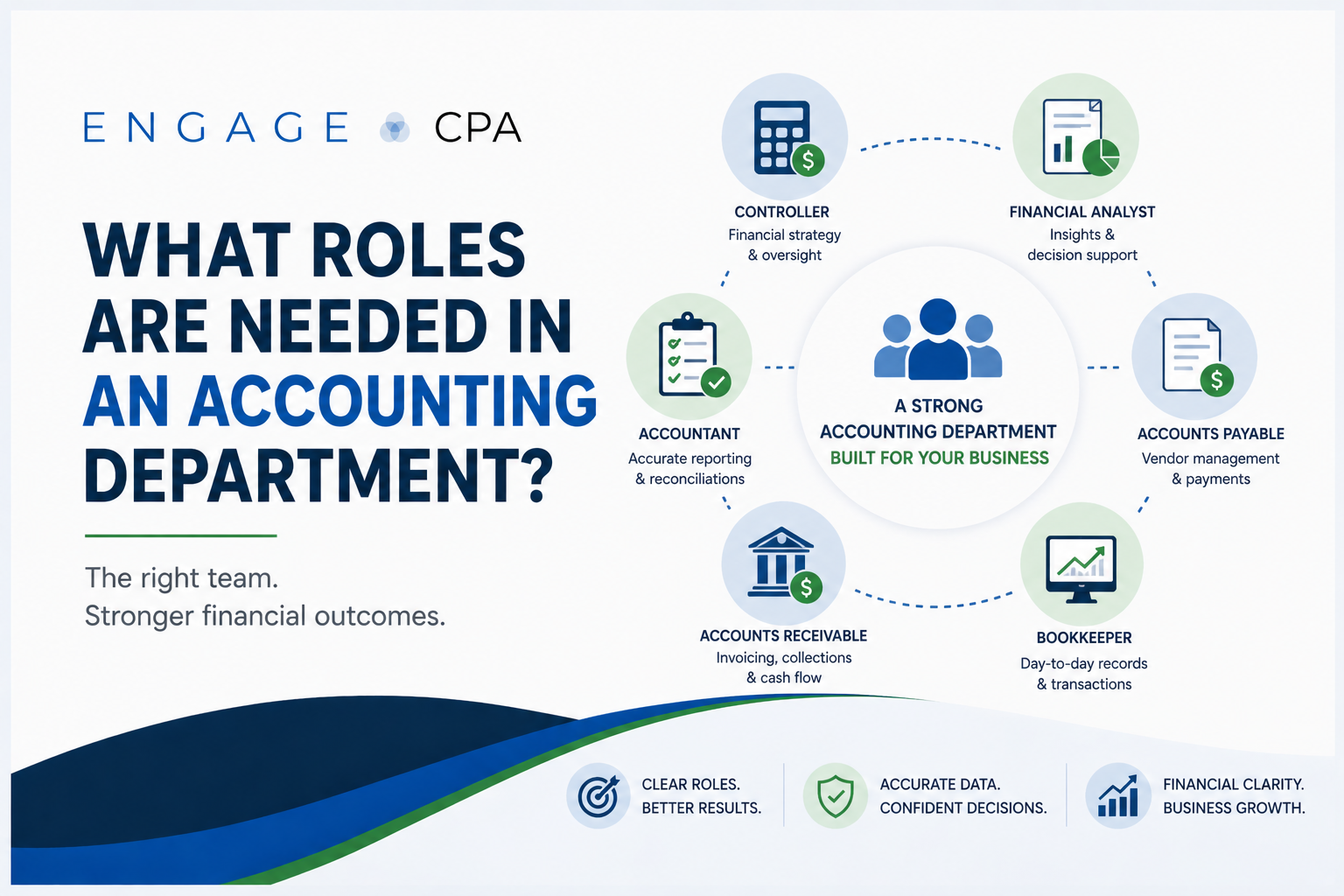
What roles are needed in an accounting department?
The answer depends on the size and complexity of the business. Not every company needs a large internal finance team. But most growing businesses eventually need the functions that an accounting department provides.
In this article, we’ll look at the most common roles found in an accounting department, what each one does, and how growing businesses often cover these needs without hiring an entire in-house team.
Why Businesses Start Thinking About Accounting Department Roles
Most businesses do not set out to build an accounting department from day one.
Instead, they reach a point where the financial side of the business becomes too important and too complex to manage informally.
This often happens when:
• financial reports start arriving late
• leadership wants more confidence in the numbers
• payroll and transaction volume increase
• year-end becomes stressful
• accounting tasks depend too heavily on one person
At that stage, the business may not just need bookkeeping. It may need the structure of an accounting department.
👉 If you’re trying to figure out whether you’ve reached that point, read:
/resources/when-does-a-business-need-an-accounting-department
What an Accounting Department Is Actually Responsible For
Before looking at the roles, it helps to understand the purpose of an accounting department.
An accounting department is responsible for the financial infrastructure of the business.
That includes:
• recording and organizing transactions
• maintaining accurate books
• producing financial reports
• managing workflows such as payables and receivables
• preparing financial records for tax and compliance
• supporting leadership with reliable financial data
Different roles handle different parts of this work.
In large organizations, these roles may all exist internally.
In growing businesses, several of these functions are often combined—or handled by an outsourced accounting department.
👉 For a fuller explanation, see:
/resources/what-is-outsourced-accounting-department
The Most Common Roles in an Accounting Department
1. Bookkeeper
The bookkeeper is often the first accounting-related role in a business.
This role typically handles:
• recording transactions
• categorizing income and expenses
• reconciling bank and credit card accounts
• maintaining basic financial records
A bookkeeper provides the foundation for the accounting function.
But in growing businesses, bookkeeping alone usually does not provide enough structure, reporting, or oversight.
👉 Related article:
/resources/bookkeeping-vs-accounting-growing-business
2. Accounts Payable / Accounts Receivable Support
As businesses grow, managing incoming and outgoing payments becomes more important.
This function often includes:
• tracking invoices
• following up on receivables
• organizing vendor payments
• maintaining payment records
In smaller businesses, these responsibilities may sit with a bookkeeper or administrator.
In larger businesses, they may be handled by dedicated team members.
3. Staff Accountant or Accountant
An accountant usually works at a broader level than a bookkeeper.
This role may be responsible for:
• reviewing financial records
• preparing financial statements
• posting adjustments
• supporting month-end close
• helping ensure reporting accuracy
As the business becomes more complex, this role becomes increasingly important for maintaining consistency and quality in financial reporting.
4. Senior Accountant
A senior accountant often adds another level of experience and oversight.
This role may be responsible for:
• reviewing reporting processes
• supporting more complex reconciliations
• handling more difficult accounting issues
• helping maintain internal consistency
Not every business needs a separate senior accountant, but many growing companies eventually need this level of capability in some form.
5. Controller
The controller is typically responsible for overseeing the accounting function at a higher level.
This role often includes:
• reviewing financial reports
• overseeing accounting workflows
• ensuring internal controls exist
• helping leadership understand financial performance
• keeping the accounting department organized and reliable
A controller is often one of the key roles businesses begin thinking about when they realize they need more than bookkeeping.
6. CFO or Strategic Finance Leader
A CFO usually sits above the accounting department rather than within it.
This role is more focused on strategy than day-to-day accounting.
Responsibilities may include:
• cash flow planning
• budgeting and forecasting
• financial strategy
• supporting growth decisions
• helping leadership plan around capital and risk
Not every growing business needs a CFO immediately.
Many businesses first need a reliable accounting department before strategic finance becomes the next priority.
Do Growing Businesses Need All of These Roles?
Usually, no.
This is one of the most important things business owners misunderstand.
A growing business may need the functions of an accounting department without needing to hire every role separately.
For example, a company may need:
• accurate bookkeeping
• monthly reporting
• payables and receivables support
• controller-level oversight
But that does not necessarily mean hiring four full-time employees.
This is why many growing businesses choose to work with an outsourced accounting department instead of building every role internally.
What Roles Are Usually Needed First?
For many businesses in the $1M–$20M range, the first needs are usually:
• bookkeeping
• monthly reporting
• organized accounting workflows
• oversight from an experienced accountant or controller
That combination often provides enough structure to improve financial visibility and reduce operational stress without immediately building a full internal team.
Internal Team vs Outsourced Accounting Department
When businesses ask what roles are needed in an accounting department, they are often really asking another question:
Do we need to hire all of this ourselves?
Often, the answer is no.
Hiring internally may require:
• recruitment
• training
• payroll cost
• benefits
• ongoing management
• coverage for vacation or turnover
An outsourced accounting department can often provide the same core functions with a structured external team.
That means the business gets:
• bookkeeping
• reporting
• financial workflow support
• year-end readiness
• CPA-level oversight
without taking on the burden of building and managing a department internally.
👉 Related article:
/resources/outsourced-accounting-vs-hiring-internal-accountant
How This Looks in Real Businesses
In practice, many growing businesses don’t need a large internal finance function right away.
What they need is:
• reliable books
• timely reporting
• consistent processes
• financial records ready for tax compliance
• someone ensuring the financial function is organized
That may look like one internal hire in some businesses.
In others, it may make much more sense to use an outsourced accounting department that already has these capabilities built in.
What Businesses in Calgary and Across Canada Often Need
For growing businesses in Calgary, Alberta, and across Canada, the need is often not for more accounting headcount.
It’s for more structure.
Many companies need the functions of:
• a bookkeeper
• an accountant
• a controller
without the cost and complexity of hiring and managing all three roles separately.
That is why outsourced accounting has become such a practical model for growing businesses.
How Engage CPA Helps
Engage CPA provides a CPA-led outsourced accounting department for growing businesses in Calgary, Alberta, and across Canada.
Our team gives businesses access to the core roles and functions they need, including:
• bookkeeping
• structured monthly reporting
• financial workflow support
• year-end and T2 readiness
• CPA-level oversight
For many companies, this provides the benefits of an accounting department without the complexity of building one internally.
Frequently Asked Questions
What is the most important role in an accounting department?
There is no single most important role. It depends on the business. Most growing companies need accurate bookkeeping, reliable reporting, and some level of financial oversight.
Does every business need a controller?
No. But many businesses eventually need controller-level oversight, even if they do not hire a full-time controller internally.
Can an outsourced accounting team cover multiple accounting roles?
Yes. That is one of the main advantages of outsourced accounting. A business can access multiple accounting functions without hiring each role separately.
Final Thoughts
The roles needed in an accounting department depend on the size, complexity, and stage of the business.
But in most cases, growing businesses do not simply need “more bookkeeping.”
They need a combination of functions:
• transaction accuracy
• financial reporting
• workflow structure
• oversight
• tax readiness
The key is not necessarily hiring every role internally.
It is making sure the business has the financial structure it needs to operate with confidence.
For many growing companies, that is exactly what an outsourced accounting department provides.

